10 Myths About the Minns Planning Reform Bill — What You Really Need to Know
Last week, I wrote to you about the Minns Government’s Planning Reform Bill — the most dangerous planning changes we’ve seen in decades.
If you’re already taking actions, thank you — your voice matters!
Opposition is growing from concerned members of the community, environmental groups, corruption experts and criticism from Parliament’s Legislation Review Committee.
There’s still more you can do. Every email, submission, and council contact strengthens our collective voice.
Here I break down 10 myths about the Bill, showing the reality behind each one and including ways you can take action, with draft emails, templates, and links.
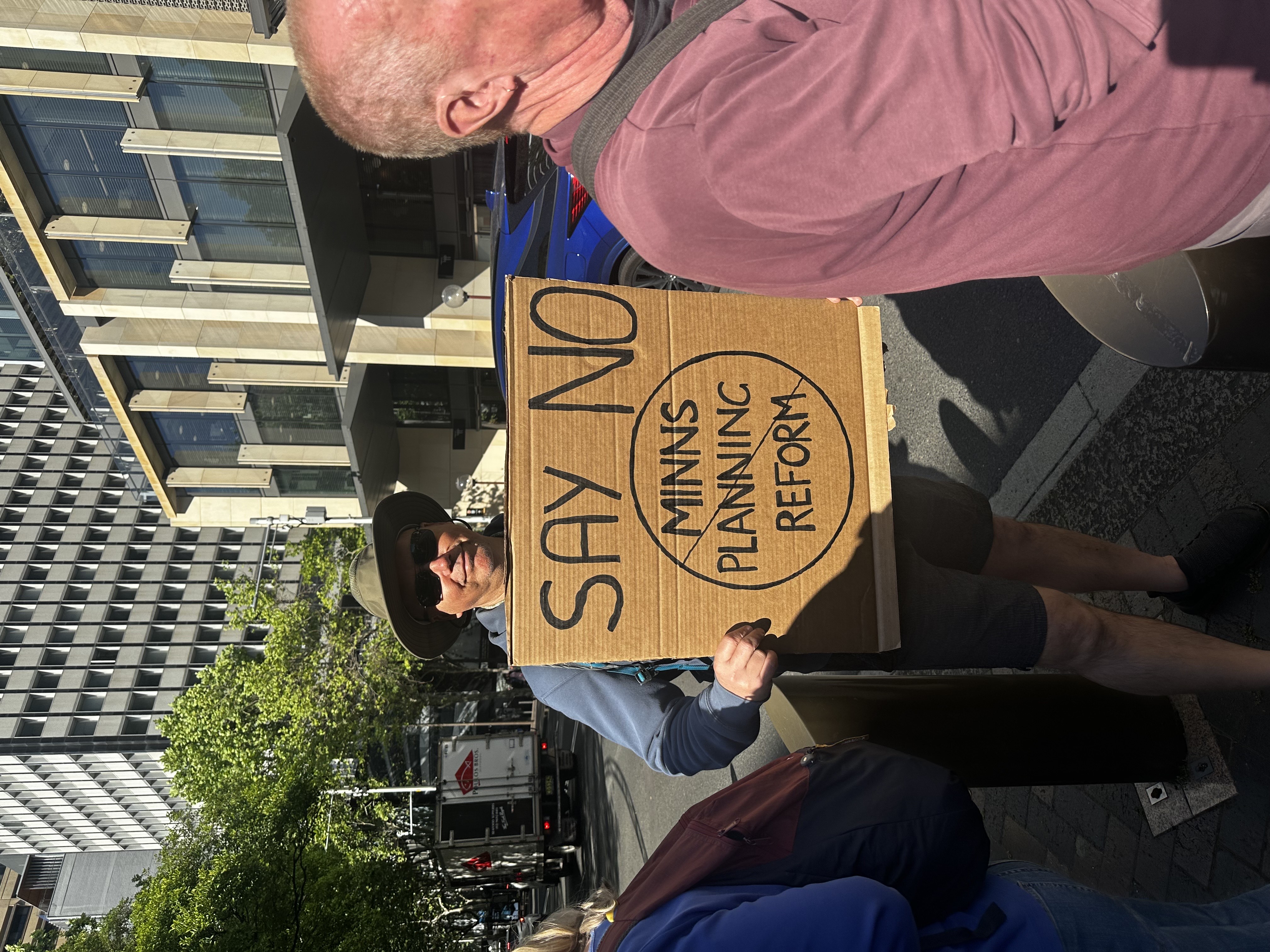
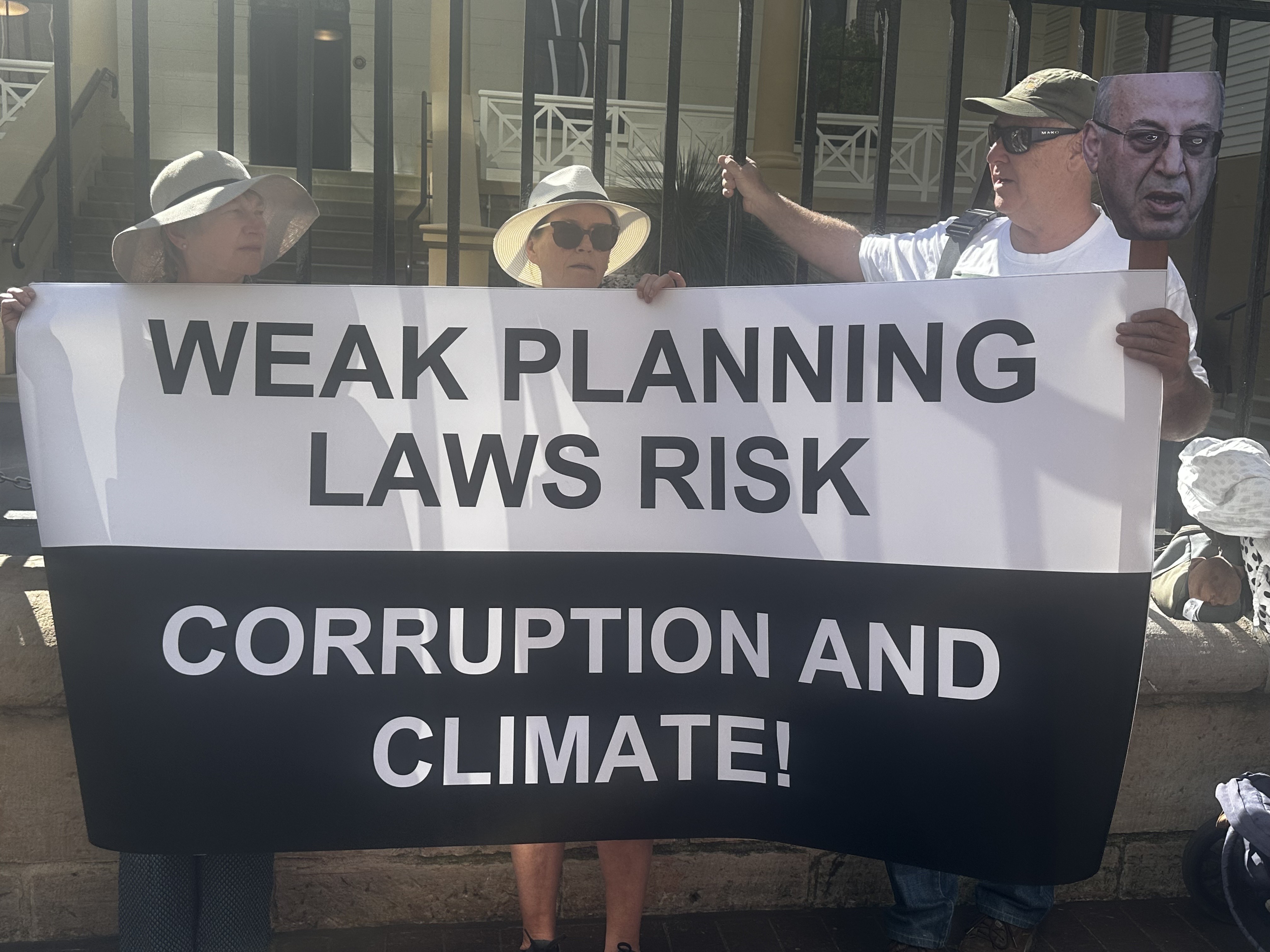
Supporters gather at Sydney’s Parliament House on 14 October 2025 to protest the Minns Government’s Planning Reform Bill. Photo: Stephanie Carrick.
You can take multiple actions — the more the better. See our Supporter Toolkit: Take Action
- Contact elected officials: Email the Premier, the Minister for Planning, and your local MP to voice objections.
- Engage with your local council: Let your council know your concerns so they can pass them to the state government.
- Be specific in your feedback: Highlight issues like traffic, local character, tree loss, or lack of infrastructure.
For further details, see the ABC News report and the EDO briefing note.
Scope of the Bill
Myth 1: It’s all about housing.
Truth: The Bill is not limited to housing. For example, the following changes will apply to any development:
- changes to what decision makers can and can’t consider in approving projects
- moving of key ministerial roles (eg, environment) to a single approval supremo (the Development Coordination Authority) for integrated development, and certain referral and concurrence roles
-
provisions allowing declaration of “targeted assessment development”
Targeted Assessment Development
Myth 2: The new “targeted assessment” framework is designed to streamline approvals for lower-risk or already-assessed projects — not to bypass environmental scrutiny.
Truth: Nothing in the Bill limits targeted assessment development to such projects, nor is low risk defined. There is nothing specifying what “already assessed” means. That is, there is nothing specifying what upfront strategic assessment or community consultation needs to have been done before something can be declared targeted assessment.
Variations to Complying Development Standards
Myth 3: Minor variations to standards, like setbacks from the lot boundary, minimum landscaping requirements or site requirements like the width of a lot, can be allowed.
Truth: The word ‘’minor’’ does not appear in the Bill and the Bill itself does not limit the extent of variations. In addition the list of variations is very wide including solar access, environment conservation and pollution. ‘’Less onerous’’ standards can apply. The deal on variations will be done behind closed doors, between decision maker and developer.
Development Coordination Authority
Myth 4: While parts of the Government have made concerted efforts to streamline their input into development proposals, there are more improvements to be made without compromising environmental outcomes. The Minister claims we have seen the benefits of interagency coordination interstate. Queensland's State Assessment and Referral Agency actively manages cases and coordinates advice from State agencies.
Truth: The benefits from the Qld model do not include no compromise on environmental outcomes. The NSW model will go further by eliminating other Ministerial voices and the need for robust and constructive debate on key issues.
The EP&A Act and EP&A Regulation already allow the Planning Secretary to step in and act on behalf of an approval body for integrated development where there are delays. A number of referral and concurrence provisions already set time periods for other agency feedback to prevent delays.
Myth 5: The authority will bring together experts from across government agencies to coordinate conditions on development applications.
Truth: Development Coordination Authority (DCA) is defined as: the Planning Secretary. While the Bill provides that the DCA may arrange for the use of the services of staff or facilities of the Department or other public authorities, and engage other experts, there is no requirement for the DCA to do this, and nothing to prevent the DCA simply exercising approval functions unilaterally.
Assessment Requirements
Myth 6: Change to assessment requirements will focus on the significant impacts of a development, so that minor impacts are not given disproportionate attention. Off-site impact assessment will also be disallowed.
Truth: There is no definition or mention of ‘’minor’’, just a broad statement allowing assessment changes. The removal of off-site impacts artificially reduces the impact of a development that could be driving major impacts. A development proposal is contemporary and its assessment uses up-to-date data, which may not have been available for an older policy or instrument.
Application of Non-Discretionary Standards
Myth 7: There can be exceedances of non-discretionary standards and, in those cases, they should be assessed on merit.
Truth: This change is about reintroducing common sense and more predictable outcomes for all parties involved. Standards are often the result of community consultation and applicable to the local area, yet it is now proposed they can be disregarded. Because it is case-by-case, it will not introduce predictability or certainty.
Corruption Concerns
Myth 8: The Bill passes ICAC tests.
Truth: Not according to former Supreme Court judge, Anthony Whealy, chair of the Centre for Public Integrity, who said it was "deceitful" to suggest the laws related only to housing and the bill strips away safeguards that are amply supported by the NSW ICAC to prevent corruption in relation to planning and development matters.
NSW Independent Commission Against Corruption (ICAC) Commissioner John Hatzistergos has said “the commission was not asked to comment on the legislation directly, but staff met with planning officials multiple times from 2024 to this year to provide ‘probity advice’".
Other
Myth 9: There will be detailed codes and policies once the Bill is passed.
Truth: There may well be, but the Bill does not contain reasonable guardrails to govern those instruments now or with future governments, to prevent significant environmental and community impacts, or safeguard against corruption.
Myth 10: The Bill supports the Government's broader environmental agenda. It also supports the agenda of everyone that needs a home, a job, a good environment.
Truth: The Government is dumbing down on a broad environmental agenda and risking a ‘good environment’. If that’s what their agenda is – then it’s no Myth!
[The myths have been drawn from the Planning Minister’s second reading speech and correspondence]
With determination,
Jeff Angel
Director, Total Environment Centre